
Custom Covers
Custom BBQ Covers Made to Fit — Why Standard Sizes Let You Down
You bought a decent BBQ. You bought a cover. And yet, here you are — a rusted burner, a warped lid, or a cover that
UK Based2–5 Year WarrantyShips Across UK & EUFree Shipping
You bought a decent BBQ. You bought a cover. And yet, here you are — a rusted burner, a warped lid, or a cover that blew off in October and ended up three gardens away. Sound familiar?
The problem is almost never the BBQ. And it is almost never neglect. It is the cover. Specifically, it is the fact that most BBQ covers are made to fit a vague size category rather than your actual grill. That gap — sometimes literal — is what lets rain in, lets wind lift it off, and lets UK weather do what UK weather does.
This post explains why standard BBQ covers consistently underperform, what a custom BBQ cover does differently, and how to get one that fits your specific grill properly.
Walk into any garden centre or scroll through any marketplace and you will find BBQ covers listed by size bracket — small, medium, large, or labelled for a specific number of burners. The logic seems reasonable until you realise how much variation exists within any of those categories.
A four-burner gas BBQ from one brand might be 130 cm wide. The same description from another brand might be 155 cm. A kettle BBQ, a kamado, a barrel smoker, and a flat-top griddle are all completely different shapes. None of them are covered well by a rectangular cover designed for a standard gas grill.
● A cover that is too large pools water on top rather than shedding it. That pooled water puts stress on the cover fabric and eventually finds its way in through the edges
● A cover that is too small leaves the base, legs, or side burners exposed — exactly the parts most vulnerable to rust
● A loose cover catches wind. In any exposed garden, it will lift, shift, or come off entirely during the first proper autumn storm
● Gaps at the base allow driven rain to get underneath, which is worse than no cover because moisture gets trapped with no way out
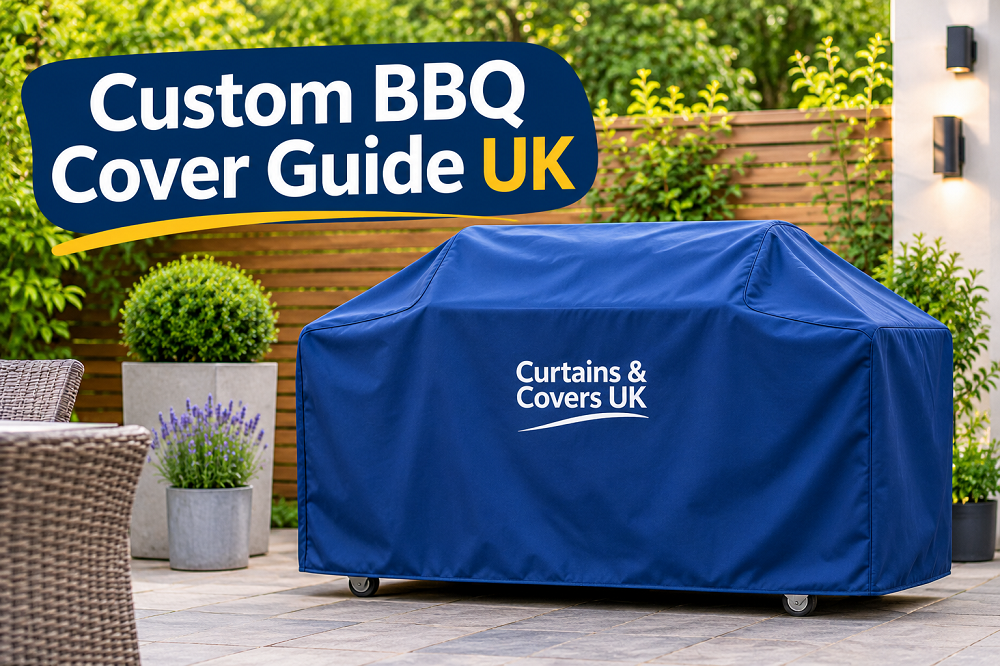
A custom BBQ cover is made to the exact dimensions of your grill. There are no gaps. There is no excess fabric. The cover sits where it is meant to sit and stays there.
When people hear “custom made,” they often assume expensive, slow, or complicated. In practice, ordering a custom BBQ cover from a UK manufacturer is straightforward.
You measure your BBQ — width, depth, and height — and send those measurements. The cover is made to fit those specific dimensions. That is it. No specialist knowledge required, no waiting weeks for a bespoke order.
Curtains & Covers UK turns around made-to-measure covers for all types of outdoor equipment, and the process is the same whether you have a compact balcony grill or a large built-in outdoor kitchen.
● Fits flat to the BBQ surface with no bunching or sagging
● Closes properly at the base with a drawstring or elasticated hem that actually pulls tight
● Has no areas of excess that catch wind or collect water
● Works for the specific shape of your grill, not just a rough size category
600D Polyester with PVC Coating
This is the standard for most residential BBQ covers and handles UK rain reliably. The 600D refers to the thread weight — it is heavier than the thin polyester in budget covers. The PVC coating is what makes it waterproof, not just water-resistant. If you are leaving your BBQ outside year-round, this is the minimum material you should be looking at.
18oz PVC Coated Vinyl
The heavy-duty option. Worth it for BBQs in exposed gardens, coastal locations, or anything that never gets moved inside. Heavier to handle, but it lasts considerably longer under sustained outdoor exposure.
What to Avoid
Thin uncoated polyester — common in cheap covers — repels light drizzle but saturates in proper rain. It also degrades in UV far faster than coated materials. After one UK winter, the fabric goes stiff, the stitching weakens, and the cover fails. You end up buying another one, which costs more in the long run than getting the right cover first.
Three measurements cover almost every BBQ shape:
● Width: the full width of the grill at the widest point, including any side shelves or tables if they will be covered
● Depth: front to back at the deepest point, including any rear-mounted controls or attachments
● Height: from the ground (or the bottom of the legs) to the highest point of the lid when closed
If your BBQ has a side burner that extends beyond the main unit, measure the full width including that. If you want the cover to include the legs and wheels, measure from the ground up. If you want it to cover the cooking area only and leave the legs exposed, measure to the base of the main unit.
Note anything unusual about the shape — a large rear burner, a prominent control panel, an offset smoker chimney. Including that detail when you order means the cover is made to account for it rather than being a generic rectangle that does not quite work.
A well-made 600D PVC-coated cover, used and stored correctly, should last four to five years. An 18oz vinyl cover lasts five to seven or more. The things that cut cover life short are storing it folded and damp, dragging it on rough surfaces, and leaving it on a hot BBQ immediately after cooking — the heat damages the inner lining over time.
Let the BBQ cool completely before covering. Store the cover dry when not in use. Fold it clean rather than bunching it into a bag while still warm and dirty.
A: Yes. Built-in outdoor kitchens and BBQ stations are one of the best use cases for a custom cover because they almost never match standard cover dimensions. Measure the full width, depth, and height of the unit — including any side sections — and the cover is made to fit the whole installation. If the unit has sections at different heights, include that in your order.
A: A cover that fits properly is far less likely to lift in the first place because there is less excess fabric for the wind to catch. Beyond that, drawstring hems pulled tight under the base of the grill are the most effective fixing. For very exposed locations, eyelets with rope or bungee cords tied to the grill legs or ground pegs give the most secure hold.
A: Yes. A pergola reduces direct rain exposure but does not eliminate it — driven rain comes in from the sides, and condensation, damp air, and UV exposure are present regardless. A cover when the BBQ is not in use adds meaningful extra protection, particularly over winter when the BBQ may sit unused for weeks or months at a time.
A: Not significantly, and when you factor in lifespan, often less. A cheap standard cover that fails in one season and needs replacing costs more over three years than a single good-quality custom cover made to fit. The price difference on the initial purchase is usually modest, and the performance difference is considerable.
A: Yes. Kamados and egg-shaped grills are a good example of why standard rectangular covers do not work well. A custom cover for a kamado is shaped to the actual profile of the grill — wider at the middle, narrower at the top — rather than being a rectangular sheet draped over a round object. Measure the widest circumference, the height from base to lid top, and note the shape, and the cover is made accordingly.
A: Yes. Curtains & Covers UK delivers to mainland UK as standard, with European delivery available. Contact us before ordering if you need delivery to a European address and we will confirm the shipping options and cost.
You bought a decent BBQ. You bought a cover. And yet, here you are — a rusted burner, a warped lid, or a cover that
UK weather is not particularly dramatic. It is not extreme cold or extreme heat. What it is, is relentless — damp, grey, windy, and unpredictable

Typically replies within a minute.