
Custom Covers
Chair Covers for Outdoor Use — What to Buy and What to Avoid
Most garden chair covers look fine on the product listing. They look less fine by February, when the seams are splitting, the fabric has gone
UK Based2–5 Year WarrantyShips Across UK & EUFree Shipping
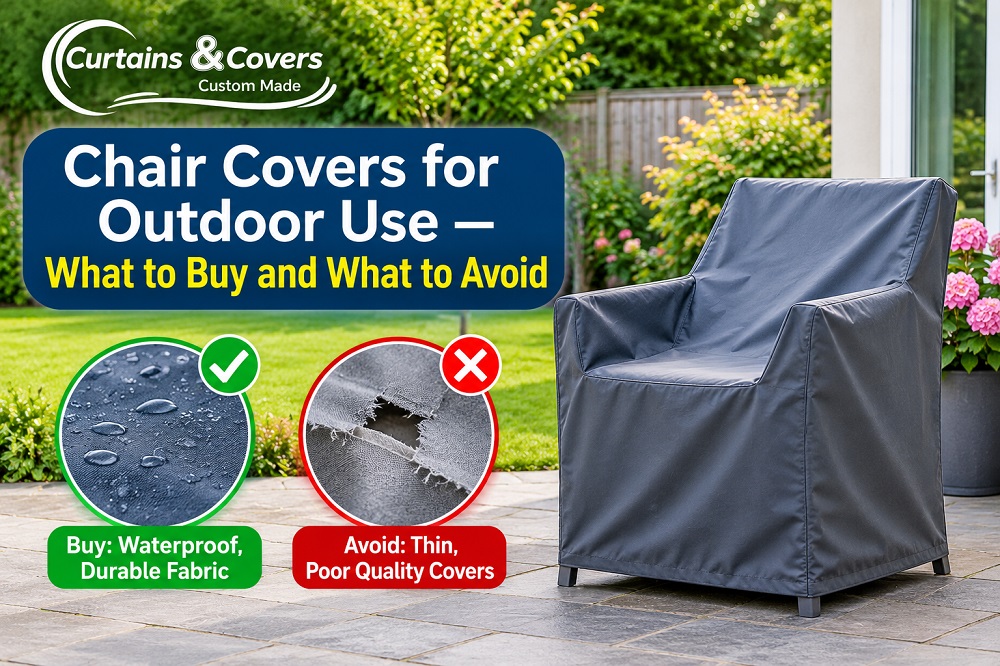
Most garden chair covers look fine on the product listing. They look less fine by February, when the seams are splitting, the fabric has gone stiff and the cover has blown off twice already. Getting this right is not complicated, but there are a few things worth knowing before you spend money.
This guide covers what actually matters when choosing outdoor chair covers — material, fit, fastening — and where most people go wrong.
Garden chairs sit outside through some of the worst weather the UK and Europe offer. Even well-made chairs deteriorate fast without protection:
A decent chair cover handles all of this. The catch is that most chairs vary enough in size that a “standard” cover is always a compromise.
This is the standard for most garden chair covers. It handles UK rain reliably, is light enough to put on and take off without effort, and holds up through a couple of seasons minimum. The PVC coating is what makes it waterproof rather than just water-resistant — that distinction matters in prolonged heavy rain.
Heavier and more durable. Worth it for chairs that stay outside year-round, or in areas with harsher winters. It costs more and weighs more, but it lasts considerably longer under sustained exposure.
Uncoated polyester repels light drizzle but soaks through in proper rain. You will find these in garden centres and discount retailers. They work for occasional use but are not built for a full British winter outdoors.
Dining chairs, stacking chairs, armchairs, Adirondack chairs and bistro chairs are all completely different shapes. A cover sized for a standard dining chair will not fit a high-backed armchair. It will not sit properly on a stacking chair either.
Standard cover sizing works for the most common shapes but leaves a lot of chairs poorly covered — too much fabric bunching at the base, gaps at the back, or a cover so loose it blows off in any wind.
Custom made-to-measure chair covers solve this by being cut to your specific chair dimensions. You measure the height, width and seat depth, and the cover is made to fit that chair. No excess fabric, no gaps, no guessing.
The cover needs to stay on. A cover that lifts off in the first October storm was a waste of money. Look for:
The heavier the cover material, the more important the fastenings. A light cover might stay put with just an elasticated hem. An 18oz PVC cover needs proper tie-downs.
If you stack your chairs for winter storage, you need a single cover for the whole stack rather than individual covers. A stacking chair cover is made to the full height of the stack and the dimensions of the widest chair. This is one of the cases where a custom cover makes the most practical sense — stack heights vary, and no off-the-shelf cover will account for your exact number of chairs and chair model.
Curtains & Covers UK makes stacking chair covers to the exact dimensions of your stack. Just measure the total height and the width of the widest chair in the stack.
A well-made 600D polyester cover with PVC coating should last three to four years outdoors with reasonable care. An 18oz PVC vinyl cover will last five years or more. The main things that shorten cover life:
Measure the height (floor to top of back), width (widest point, usually the arms or back), and seat depth (front edge to back). If the chair is adjustable, measure at its largest. For a made-to-measure cover, send those three measurements and the cover is cut to fit exactly.
Yes — custom made-to-measure covers can be made for any chair shape, including high-backed armchairs, Adirondack chairs, egg chairs and bench-style garden seating. The process is the same: measure the overall height, width and depth, and note anything unusual in the order.
It depends on the material. Water-resistant polyester handles light rain. A fully waterproof cover uses PVC-coated fabric — that handles sustained heavy rain. If your chairs stay outside all winter in the UK, PVC-coated is worth the extra cost.
Yes, if possible. Cushions store best indoors over winter. If you cannot remove them, make sure the cover has ventilation to prevent moisture building up underneath — trapped damp causes mildew on cushion fabric far faster than open-air exposure.
Yes. A stacking chair cover is made to fit the full height and width of the stacked pile rather than individual chairs. Measure the total stack height and the widest chair in the stack, and a single cover can protect the whole set.
Yes. Curtains & Covers UK delivers to mainland UK as standard, with shipping available to Europe. Contact us before ordering if you need delivery to a European address and we will confirm the shipping cost.
Most garden chair covers look fine on the product listing. They look less fine by February, when the seams are splitting, the fabric has gone
Gazebo covers help protect one of the most-loved features of a UK garden from the unpredictable British weather. While many people remember to store away

Typically replies within a minute.